
Guide
How to Lower High-Risk Car Insurance Rates
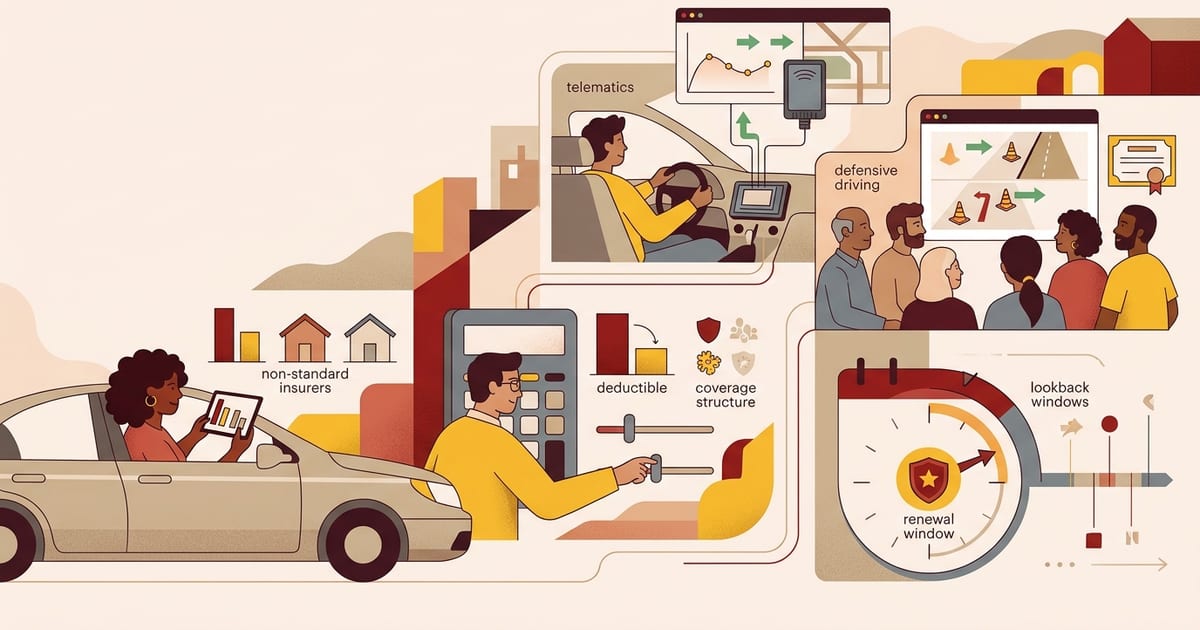
The actions that lower a high-risk premium most: comparing non-standard and standard insurers, deductibles, coverage structure, telematics, defensive driving, and timing renewals to lookback windows.

By Rebecca Lind · Research Writer
Published · Updated
Answer in brief
For a high-risk driver, the lever that dwarfs the rest is comparing insurers—spreads of two to three times for the same driver are common. After that: raise deductibles (the dollar saving is larger on a high base), drop collision on a low-value car, enrol in telematics to prove current behaviour, take a defensive-driving course where it earns a discount or removes points, restore lost discounts, and time your comparisons to the renewals nearest the three- and five-year marks after each incident, when insurers with shorter lookbacks stop counting it.
Actions ranked
| Action | Typical saving | Notes |
|---|---|---|
| Compare 4–6 insurers incl. non-standard | 30–60% | The main lever |
| Raise deductibles to $1,000 | 15–25% of collision/comp | Large dollar saving on high base |
| Drop collision on a low-value car | Up to 40% of premium | Keep comp if cheap |
| Telematics | 5–30% | Proves current driving |
| Defensive driving course | 5–10% or point removal | State-dependent |
| Pay in full | 5–10% | Avoids installment fees too |
| Restore discounts (bundle, autopay, paperless) | 5–20% | Often lost at the incident |
| Clean record from here | Surcharges expire in 3–5 years | The long game |
Timing
Insurers rate three or five years of history. In years four and five after an incident, the company with a three-year lookback may price you as standard while your current one still counts the event. Compare at the renewal nearest each anniversary.
What not to do
Do not drop liability limits to save money, do not let the policy lapse, and do not go uninsured to wait out the surcharge—each makes the next policy more expensive.
Quote finder
Find auto insurance quotes that fit your situation
Entries in this guide
Specific questions answered in more depth.
Questions & answers
What is the fastest way to lower high-risk insurance?
Compare several insurers, including non-standard specialists. Spreads for high-risk drivers are the widest in the market.
Does a defensive driving course help?
In many states it removes points or earns a discount; some insurers also reduce surcharges for it.
How long until I'm not high-risk?
Three to five years from the last incident, with the price stepping down at each clean renewal.
Terms used in this guide
- Deductible
- What you pay before collision or comprehensive pays. Raising it saves more in dollars when the base premium is high.
- Telematics (usage-based insurance)
- Pricing based partly on measured driving. Lets a high-risk driver prove current behaviour before the record catches up.
- Lookback period
- How many years of record an insurer rates—three and five are common. Determines when an incident stops affecting your price.
- Surcharge
- A percentage added to the premium for a specific incident, typically for three years.
Sources and references
Legal figures on this page (minimum limits, filing periods, statutory benefits) are checked against the primary law or the state insurance regulator listed below. Links and figures last verified Nov 2026.
- Background on: Pay-as-you-drive auto insurance (telematics) — Insurance Information InstituteIndependent researchUsage-based and per-mile pricing models, what telematics programmes measure, and state limits on their use.
- Trends and Insights: Auto insurance rates (June 2024) — Insurance Information Institute (2024)Independent researchWhy premiums rose 2021–2024: crash frequency and severity, repair and labour inflation, vehicle technology, attorney involvement.
- 2019–2023 Auto Insurance Database: average premium supplement — National Association of Insurance Commissioners (2025)Statistical dataCountrywide average expenditure $1,281 in 2023 (+13.98%); combined average premium $1,438; state tables for liability, collision and comprehensive.
- Facts + Statistics: Auto insurance — Insurance Information Institute (2025)Statistical dataNAIC countrywide average auto expenditure: $1,127 (2022), $1,282 (2023); most expensive states in 2023 were Florida, Louisiana and New York.
- Nine ways to lower your auto insurance costs — Insurance Information InstituteConsumer guidanceShop at least three quotes; raising a deductible from $200 to $500 can cut collision/comprehensive cost 15–30%, $1,000 can save 40%+; drop physical damage on cars worth under 10× the premium; bundling, low-mileage and good-student discounts.
- What determines the price of an auto insurance policy? — Insurance Information InstituteConsumer guidanceRating factors: driving record, mileage, location, age, gender, vehicle, credit-based insurance score, coverage choices. Notes ZIP-code rating is prohibited in California and Michigan and gender rating is prohibited in seven states.
- What if I can't find auto coverage? — Insurance Information InstituteConsumer guidanceHow the non-standard market and state assigned-risk plans insure drivers the voluntary market declines.
- Is it legal to drive without insurance? — Insurance Information InstituteConsumer guidanceEvery state requires drivers to demonstrate financial responsibility; in most states insurance is the mandatory way to do so.
Practical guidance on this page is original editorial work. Cited sources support factual statements and do not endorse this site. Dollar ranges described as typical or illustrative are editorial estimates, not figures from these sources.
Guide
How to Compare High-Risk Car Insurance Quotes
A comparison method for high-risk drivers: disclose everything, fix coverage, include non-standard and standard insurers, confirm filings, add fees, and bind before cancelling.
Guide
How Much High-Risk Car Insurance Costs
Typical premiums for high-risk drivers by trigger, how surcharges and tier changes combine, and why the quote spread is wider than for any other group.
Guide
Non-Standard Auto Insurers Explained
What the non-standard auto insurance market is, how it differs from standard and preferred, what to expect in pricing, service and policy terms, and when to use it.