
Guide
SR-22 Insurance for High-Risk Drivers
What an SR-22 is, which situations require one, how long it lasts, what it costs, FR-44 in Florida and Virginia, and how to get one filed without a lapse.

By Rebecca Lind · Research Writer
Published · Updated
Answer in brief
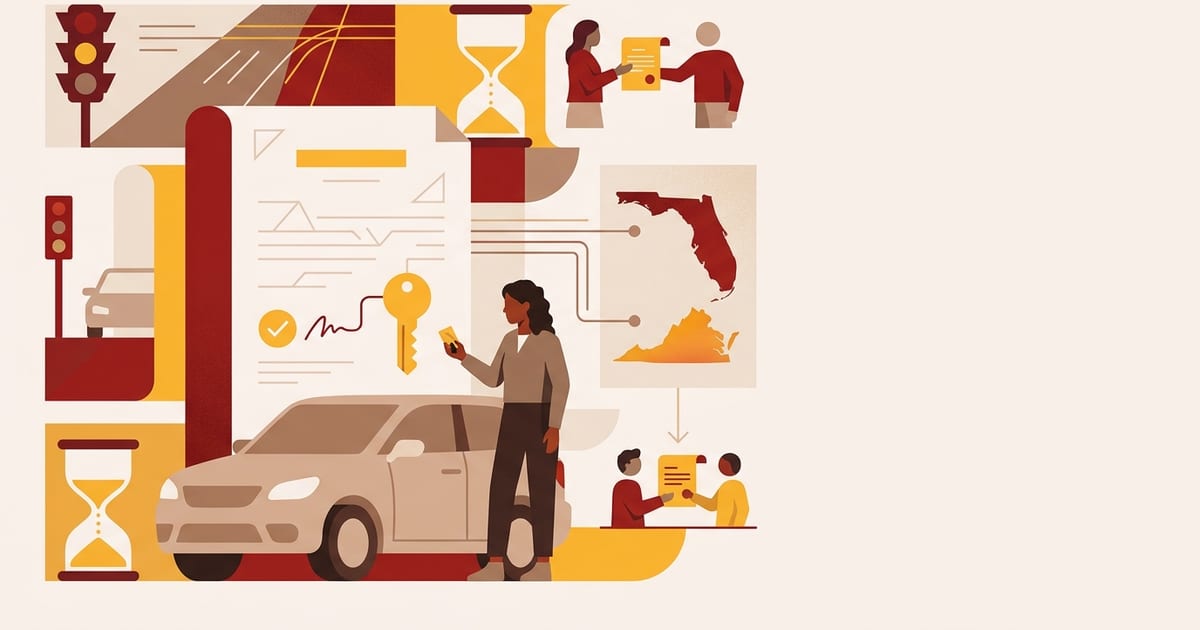
An SR-22 is a certificate your insurer files with your state proving you carry at least the required liability coverage; the insurer must also notify the state if the policy lapses. It is required after a DUI, driving uninsured, an at-fault accident while uninsured, excessive points or a licence suspension, typically for three years. The filing fee is small (around $15–$50); the cost is the high-risk premium behind it. Florida and Virginia use an FR-44 with higher limits after a DUI. Drivers without a car satisfy the requirement with a non-owner SR-22.
What it is and isn't
The SR-22 is not insurance and cannot be bought alone. It is a form attached to a liability policy. Only insurers that write filings in your state can provide one—ask before quoting.
Who needs one
- DUI/DWI conviction (FR-44 in Florida and Virginia).
- Driving without insurance, or an at-fault crash while uninsured.
- Licence suspension or revocation for points or other causes.
- Repeated serious violations.
- Reinstating a licence after certain unpaid judgments.
Duration and lapses
Most states require three years of continuous filing. If the policy cancels, the insurer files a notice, the licence is re-suspended and the clock often restarts. When switching insurers, bind the new policy with the filing before the old one ends.
Cost
| Component | Typical cost |
|---|---|
| Filing fee | $15–$50 one-time |
| Premium increase from the underlying violation | 50–150% |
| Non-owner SR-22 policy | $300–$900/year |
| FR-44 (FL/VA) with 100/300/50 limits | Substantially higher than SR-22 |
Quote finder
Find auto insurance quotes that fit your situation
Without a car
A non-owner liability policy can carry the filing. It covers you driving borrowed or rented cars and is usually far cheaper than an owner policy. It does not cover a car you own or one regularly available to you.
Questions & answers
How do I get an SR-22?
Buy a liability policy from an insurer that files in your state and ask for the SR-22; they file electronically, often the same day.
How long do I need an SR-22?
Usually three years; some states two to five.
What happens if my SR-22 policy cancels?
The insurer notifies the state, your licence is suspended again and the filing period may restart.
Terms used in this guide
- SR-22
- A certificate of financial responsibility an insurer files with the state, proving liability coverage and promising to report a lapse. Required after DUI, uninsured driving, suspensions.
- FR-44
- The higher-limit filing Florida and Virginia require after a DUI instead of an SR-22.
- Financial responsibility
- The legal duty to be able to pay for damage you cause while driving, met by liability insurance. SR-22/FR-44 filings are proof of it.
- Non-owner policy
- Liability coverage for a driver without a car. Carries SR-22 filings and keeps coverage history continuous.
Sources and references
Legal figures on this page (minimum limits, filing periods, statutory benefits) are checked against the primary law or the state insurance regulator listed below. Links and figures last verified Nov 2026.
- Trends and Insights: Auto insurance rates (June 2024) — Insurance Information Institute (2024)Independent researchWhy premiums rose 2021–2024: crash frequency and severity, repair and labour inflation, vehicle technology, attorney involvement.
- Automobile financial responsibility limits by state — Insurance Information Institute (2023)Statistical dataCompulsory coverages and minimum liability limits by state (table dated December 2023 — several states have raised limits since; see statute entries).
- 2019–2023 Auto Insurance Database: average premium supplement — National Association of Insurance Commissioners (2025)Statistical dataCountrywide average expenditure $1,281 in 2023 (+13.98%); combined average premium $1,438; state tables for liability, collision and comprehensive.
- Facts + Statistics: Auto insurance — Insurance Information Institute (2025)Statistical dataNAIC countrywide average auto expenditure: $1,127 (2022), $1,282 (2023); most expensive states in 2023 were Florida, Louisiana and New York.
- What is covered by a basic auto insurance policy? — Insurance Information InstituteConsumer guidanceDefines bodily injury and property damage liability, MedPay, PIP, uninsured/underinsured motorist, collision, comprehensive and glass coverage.
- Consumer insurance information — National Association of Insurance CommissionersConsumer guidancePlain-language guides from the body of state insurance regulators; links to every state's insurance department and complaint process.
- What if I can't find auto coverage? — Insurance Information InstituteConsumer guidanceHow the non-standard market and state assigned-risk plans insure drivers the voluntary market declines.
- Is it legal to drive without insurance? — Insurance Information InstituteConsumer guidanceEvery state requires drivers to demonstrate financial responsibility; in most states insurance is the mandatory way to do so.
Practical guidance on this page is original editorial work. Cited sources support factual statements and do not endorse this site. Dollar ranges described as typical or illustrative are editorial estimates, not figures from these sources.
Guide
Non-Standard Auto Insurers Explained
What the non-standard auto insurance market is, how it differs from standard and preferred, what to expect in pricing, service and policy terms, and when to use it.
Guide
High-Risk Insurance After a Coverage Lapse or Suspension
Getting insured after a lapse, a suspended licence or a period without a car: how insurers treat gaps, reinstatement filings, and the cheapest route back to continuous coverage.
Guide
How to Compare High-Risk Car Insurance Quotes
A comparison method for high-risk drivers: disclose everything, fix coverage, include non-standard and standard insurers, confirm filings, add fees, and bind before cancelling.