
Entry in How to Lower High-Risk Car Insurance Rates
Adjusting Deductibles and Coverages to Lower High-Risk Auto Rates
Learn how raising deductibles and dropping optional physical damage coverage can reduce high-risk car insurance premiums while maintaining legal compliance.

By Rebecca Lind · Research Writer
Published
Answer in brief
High-risk car insurance surcharges dramatically raise base rates, making coverage adjustments an effective way to control total expenditures. By raising collision and comprehensive deductibles or dropping physical damage on older vehicles, drivers can secure meaningful premium reductions without dropping essential liability protection. Comparing quotes from multiple non-standard carriers ensures you capture these savings while maintaining required coverage limits.
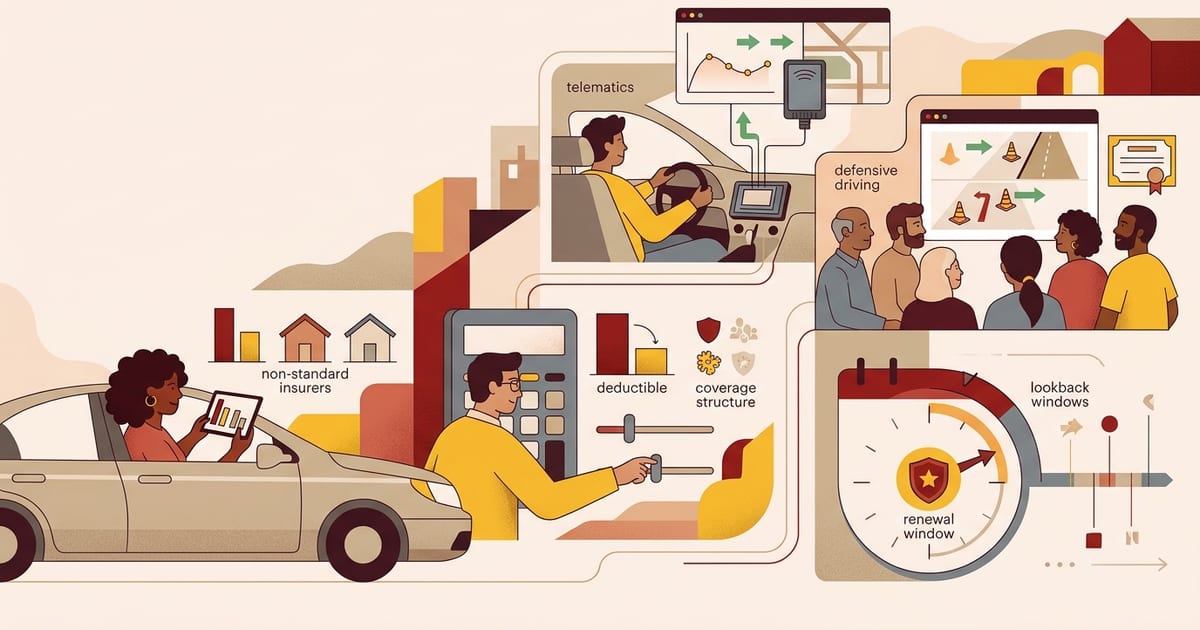
How Policy Deductibles Impact High-Risk Premiums
When a driver is assigned to a high-risk rating tier following moving violations, crashes, or coverage gaps, insurers apply an underwriting surcharge across the policy. Because surcharges are calculated as percentage increases applied against base premiums, high-risk policyholders experience disproportionately large dollar increases across both liability and physical damage components.
According to data from the National Association of Insurance Commissioners, the countrywide average expenditure for auto insurance reached $1,281 in 2023, representing a 13.98% single-year increase, with combined average premiums climbing to $1,438. For drivers in the non-standard market, typical annual premiums can run substantially higher, often between $2,000 and $4,500 annually depending on jurisdiction and incident severity. Strategic adjustments to physical damage deductible amounts offer an immediate, effective mechanism to reduce these elevated expenses.
Industry benchmark studies from the Insurance Information Institute confirm that raising your physical damage deductible from $200 to $500 can reduce collision and comprehensive premium costs by 15% to 30%. Elevating the deductible further to $1,000 routinely generates savings of 40% or more on those specific coverage elements. When base collision premiums are already inflated by high-risk surcharges, these percentage reductions translate into hundreds of dollars in annual savings.
Understanding Physical Damage Coverages
To restructure a high-risk policy safely, drivers must understand the distinct roles played by the primary coverage parts. Unlike compulsory bodily injury and property damage liability—which pay for damages and injuries inflicted on third parties—collision and comprehensive cover damage to your own vehicle.
Collision coverage reimburses damage resulting from an impact with another vehicle or object, or from vehicle rollover. Comprehensive coverage applies to non-collision perils, such as theft, hail, vandalism, flood, or contact with animals. If a vehicle is financed or leased, lienholders legally mandate both collision and comprehensive coverage with strict deductible ceilings. However, once a vehicle is owned outright, carrying physical damage protection becomes an elective financial decision.
- 1
Review Your Policy Declarations Page
Examine the itemized premium breakdown to identify precisely what portion of your annual expenditure pays for collision and comprehensive protection versus compulsory liability.
- 2
Establish Vehicle Current Market Value
Check reliable vehicle valuation guides to confirm the actual market worth of your vehicle before making structural coverage decisions.
- 3
Model Deductible Adjustments
Obtain comparative quotes showing the rate impact of shifting your deductible from $250 or $500 up to $1,000 or $1,500, ensuring you maintain sufficient emergency reserves to cover the out-of-pocket amount.
- 4
Evaluate Dropping Physical Damage
If the vehicle value is modest and you own the title free of liens, calculate your savings if you transition to a liability-only policy structure.
- 5
Shop Multiple Non-Standard Carriers
Underwriting formulas vary widely across non-standard insurers; comparison shopping allows you to pair higher deductibles with carriers that feature lower baseline surcharges.
Where Drivers Should Never Cut Coverage
While adjusting deductibles is an effective cost-containment strategy, reducing compulsory liability protection down to absolute state minimums exposes high-risk motorists to catastrophic financial liability. State financial responsibility minimums serve as a statutory floor rather than an adequate protective ceiling. If an at-fault accident results in severe medical expenses or property claims exceeding statutory minimum limits, the policyholder remains personally responsible for paying all remaining judgments.
Furthermore, opting into optional usage-based telematics programs can provide an alternative path to rate relief for high-risk drivers willing to demonstrate safe driving habits over time. Rather than sacrificing vital liability shields, drivers reduce their high-risk expenditure most reliably by raising deductibles, removing unneeded physical damage on older cars, and shopping across independent non-standard carriers.
Questions & answers
How much can I save on high-risk insurance by raising my deductible?
Raising your collision and comprehensive deductible from $200 to $500 typically lowers physical damage premiums by 15% to 30%, while increasing it to $1,000 can generate savings of 40% or more on those coverages.
When is it advisable for a high-risk driver to drop collision and comprehensive coverage?
When an owned vehicle is worth less than 10 times the annual cost of physical damage coverage, dropping collision and comprehensive is generally financially sensible.
Does raising my deductible reduce my bodily injury liability premium?
No. Deductibles apply exclusively to physical damage coverages (collision and comprehensive). Liability coverages do not carry deductibles and are priced according to selected liability policy limits.
Can high-risk drivers use telematics to lower their rates?
Yes. Usage-based telematics programs track driving metrics such as braking, speed, and mileage. Demonstrating safe driving behavior over time can help qualify drivers for lower rating tiers.
Terms: Deductible, Surcharge, Premium, Rating tier, Telematics (usage-based insurance)
Sources and references
Legal figures on this page (minimum limits, filing periods, statutory benefits) are checked against the primary law or the state insurance regulator listed below. Links and figures last verified Nov 2026.
- Background on: Pay-as-you-drive auto insurance (telematics) — Insurance Information InstituteIndependent researchUsage-based and per-mile pricing models, what telematics programmes measure, and state limits on their use.
- 2019–2023 Auto Insurance Database: average premium supplement — National Association of Insurance Commissioners (2025)Statistical dataCountrywide average expenditure $1,281 in 2023 (+13.98%); combined average premium $1,438; state tables for liability, collision and comprehensive.
- Facts + Statistics: Auto insurance — Insurance Information Institute (2025)Statistical dataNAIC countrywide average auto expenditure: $1,127 (2022), $1,282 (2023); most expensive states in 2023 were Florida, Louisiana and New York.
- Nine ways to lower your auto insurance costs — Insurance Information InstituteConsumer guidanceShop at least three quotes; raising a deductible from $200 to $500 can cut collision/comprehensive cost 15–30%, $1,000 can save 40%+; drop physical damage on cars worth under 10× the premium; bundling, low-mileage and good-student discounts.
- Understanding your insurance deductibles — Insurance Information InstituteConsumer guidanceHow deductibles apply to collision and comprehensive and how raising them lowers premium.
- How much auto coverage do I need? — Insurance Information InstituteConsumer guidanceWhy state minimums are a floor; choosing liability limits that protect assets; when collision and comprehensive are worth keeping.
- What is covered by a basic auto insurance policy? — Insurance Information InstituteConsumer guidanceDefines bodily injury and property damage liability, MedPay, PIP, uninsured/underinsured motorist, collision, comprehensive and glass coverage.
- How to file an auto insurance claim — Insurance Information InstituteConsumer guidanceSteps after a crash: document the scene, notify the insurer promptly, understand the adjuster's role.
Practical guidance on this page is original editorial work. Cited sources support factual statements and do not endorse this site. Dollar ranges described as typical or illustrative are editorial estimates, not figures from these sources.