
Guide
How to Compare High-Risk Car Insurance Quotes
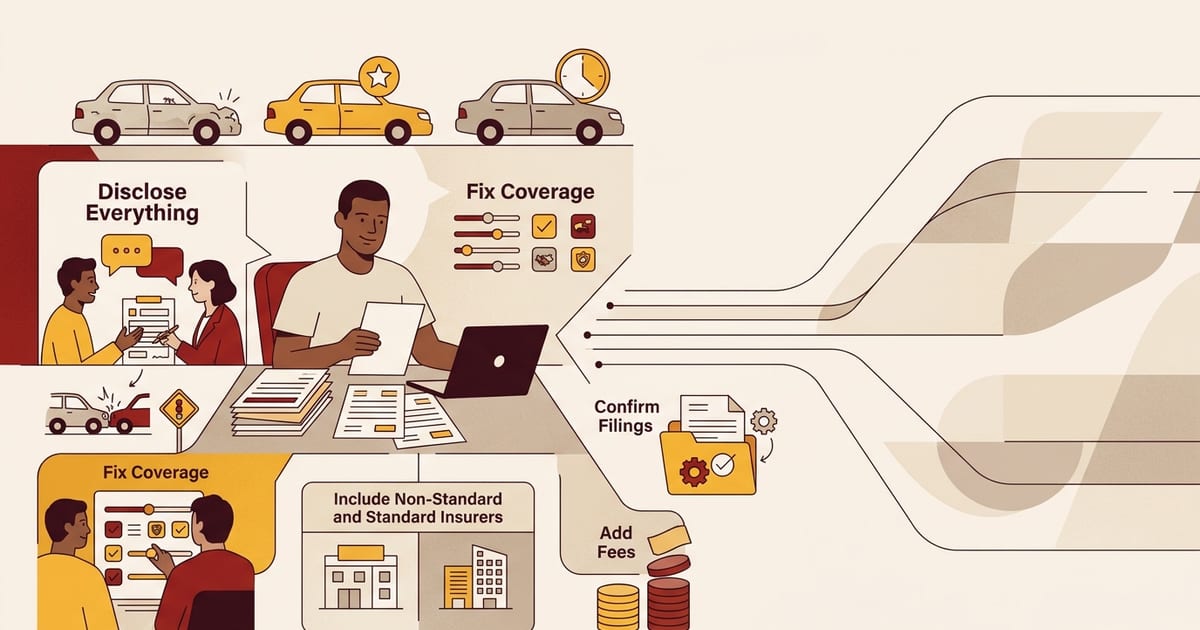
A comparison method for high-risk drivers: disclose everything, fix coverage, include non-standard and standard insurers, confirm filings, add fees, and bind before cancelling.

By Gabriel Ortiz · Editor
Published · Updated
Answer in brief
High-risk comparison rewards breadth and honesty. Disclose every incident up front—insurers pull records anyway, and an undisclosed one re-rates or voids the policy. Fix the coverage set, including any SR-22 requirement, and quote four to six insurers spanning non-standard and standard. Confirm filing capability and fees, compare annual totals, and bind the new policy before cancelling the old. Expect the spread between highest and lowest to be two to three times.
- 1
Gather your record
Conviction dates, accident dates and payouts, any filing requirement letter, current declarations page.
- 2
Fix the coverage
Liability limits (100/300 if you can; the filing minimum if not), UM, deductibles, collision/comp decision per car.
- 3
Quote widely
Four to six insurers—mainstream, standard and non-standard. A comparison tool reaches several at once.
- 4
Ask the high-risk questions
Do you file SR-22s? How many years do you rate this violation? What fees apply? Is accident forgiveness available later?
- 5
Normalise
Annual total including filing, installment and policy fees.
- 6
Bind first, cancel second
Avoid a lapse; get written confirmation any filing was accepted.
Why disclosure matters
Every insurer pulls your motor vehicle record and claims history before binding or at first renewal. An undisclosed incident does not stay hidden; it produces a re-rate, a cancellation, or in the worst case a denied claim for misrepresentation. Disclose everything and let the price be the price.
Questions & answers
How many quotes should a high-risk driver get?
Four to six, spanning standard and non-standard insurers.
Should I disclose a ticket the insurer might not find?
Yes. Insurers pull records; an undisclosed incident can void the policy.
Do quotes affect my credit?
No. Insurance quotes are soft inquiries.
Terms used in this guide
- Premium
- The price of a policy, per six or twelve months.
- SR-22
- A certificate of financial responsibility an insurer files with the state, proving liability coverage and promising to report a lapse. Required after DUI, uninsured driving, suspensions.
- Non-standard insurance
- The market segment specialising in high-risk drivers. Provides SR-22 filings and non-owner policies routinely; base rates higher, incident surcharges often smaller.
Sources and references
Legal figures on this page (minimum limits, filing periods, statutory benefits) are checked against the primary law or the state insurance regulator listed below. Links and figures last verified Nov 2026.
- Automobile financial responsibility limits by state — Insurance Information Institute (2023)Statistical dataCompulsory coverages and minimum liability limits by state (table dated December 2023 — several states have raised limits since; see statute entries).
- Nine ways to lower your auto insurance costs — Insurance Information InstituteConsumer guidanceShop at least three quotes; raising a deductible from $200 to $500 can cut collision/comprehensive cost 15–30%, $1,000 can save 40%+; drop physical damage on cars worth under 10× the premium; bundling, low-mileage and good-student discounts.
- Consumer insurance information — National Association of Insurance CommissionersConsumer guidancePlain-language guides from the body of state insurance regulators; links to every state's insurance department and complaint process.
- Insurance research and advocacy — Consumer Federation of AmericaConsumer guidanceConsumer-side research on auto insurance pricing, non-driving rating factors and affordability.
- What if I can't find auto coverage? — Insurance Information InstituteConsumer guidanceHow the non-standard market and state assigned-risk plans insure drivers the voluntary market declines.
- Is it legal to drive without insurance? — Insurance Information InstituteConsumer guidanceEvery state requires drivers to demonstrate financial responsibility; in most states insurance is the mandatory way to do so.
- Car insurance — Consumer ReportsConsumer guidanceIndependent testing organisation's guides to comparing policies and insurers.
- Auto insurance basics — United PolicyholdersConsumer guidancePlain-language coverage explanations from a policyholder-advocacy non-profit.
Practical guidance on this page is original editorial work. Cited sources support factual statements and do not endorse this site. Dollar ranges described as typical or illustrative are editorial estimates, not figures from these sources.
Guide
How to Lower High-Risk Car Insurance Rates
The actions that lower a high-risk premium most: comparing non-standard and standard insurers, deductibles, coverage structure, telematics, defensive driving, and timing renewals to lookback windows.
Guide
Non-Standard Auto Insurers Explained
What the non-standard auto insurance market is, how it differs from standard and preferred, what to expect in pricing, service and policy terms, and when to use it.
Guide
SR-22 Insurance for High-Risk Drivers
What an SR-22 is, which situations require one, how long it lasts, what it costs, FR-44 in Florida and Virginia, and how to get one filed without a lapse.