
Guide
How Much High-Risk Car Insurance Costs
Typical premiums for high-risk drivers by trigger, how surcharges and tier changes combine, and why the quote spread is wider than for any other group.

By Rebecca Lind · Research Writer
Published · Updated
Answer in brief
High-risk drivers typically pay 50–150% more than a clean-record driver of the same age and location, with a DUI or multiple accidents at the top of that range. The increase has two parts: a surcharge for each incident and often a tier change to a higher base rate. Because insurers draw the high-risk line differently, the gap between the highest and lowest quote for the same high-risk driver is routinely two to three times—far wider than for standard drivers—which makes comparing more valuable here than anywhere else in auto insurance.
Typical increases by trigger
| Situation | Typical premium vs clean record |
|---|---|
| One at-fault accident | 130–160% |
| Two at-fault accidents | 180–250% |
| Reckless driving | 160–220% |
| DUI, first offence | 160–210% |
| DUI + SR-22 filing | 170–230% |
| Lapse over 30 days | 110–130% |
| Suspended licence reinstatement with SR-22 | 150–200% |
Surcharge plus tier
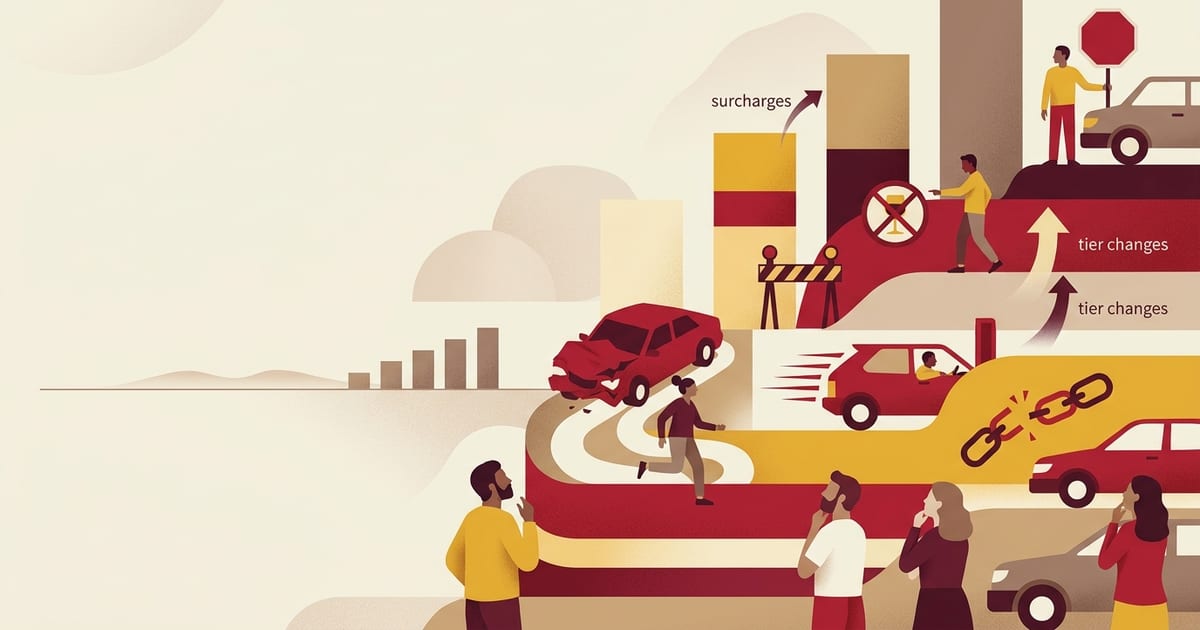
A surcharge is a percentage added for a specific incident. A tier change moves you to a different rate table—or a different company within the same group—with a higher base. A driver with a DUI often experiences both: a 50% surcharge on a base rate that is itself 40% higher than before. Multiplied, that is 210% of the old premium.
Why spreads are so wide
A preferred insurer that does not want high-risk business prices it to discourage—or declines. A non-standard specialist prices it to win. Between those two, quotes for the same driver can differ by a factor of two or three. The comparison guide covers how to find the lower end.
Questions & answers
How much more do high-risk drivers pay?
Typically 50–150% more than a clean-record driver, depending on the trigger and the insurer.
Why did one insurer quote me three times another?
The higher quote is probably from a company that would rather not write your risk. Neither is wrong; take the lower one.
How long will I pay high-risk rates?
Three to five years from the last incident, stepping down at each clean renewal.
Terms used in this guide
- Surcharge
- A percentage added to the premium for a specific incident, typically for three years.
- Rating tier
- A pricing group with its own base rates. Incidents can move a driver from a preferred to a standard or non-standard tier.
- Premium
- The price of a policy, per six or twelve months.
- Non-standard insurance
- The market segment specialising in high-risk drivers. Provides SR-22 filings and non-owner policies routinely; base rates higher, incident surcharges often smaller.
Sources and references
Legal figures on this page (minimum limits, filing periods, statutory benefits) are checked against the primary law or the state insurance regulator listed below. Links and figures last verified Nov 2026.
- Facts + Statistics: Alcohol-impaired driving — Insurance Information InstituteStatistical dataAlcohol-impaired crash fatalities, BAC thresholds and state ignition-interlock context.
- Facts + Statistics: Highway safety — Insurance Information InstituteStatistical dataCrash, injury and fatality trends used to explain why liability and injury coverages cost what they do.
- 2019–2023 Auto Insurance Database: average premium supplement — National Association of Insurance Commissioners (2025)Statistical dataCountrywide average expenditure $1,281 in 2023 (+13.98%); combined average premium $1,438; state tables for liability, collision and comprehensive.
- Facts + Statistics: Auto insurance — Insurance Information Institute (2025)Statistical dataNAIC countrywide average auto expenditure: $1,127 (2022), $1,282 (2023); most expensive states in 2023 were Florida, Louisiana and New York.
- What determines the price of an auto insurance policy? — Insurance Information InstituteConsumer guidanceRating factors: driving record, mileage, location, age, gender, vehicle, credit-based insurance score, coverage choices. Notes ZIP-code rating is prohibited in California and Michigan and gender rating is prohibited in seven states.
- Nine ways to lower your auto insurance costs — Insurance Information InstituteConsumer guidanceShop at least three quotes; raising a deductible from $200 to $500 can cut collision/comprehensive cost 15–30%, $1,000 can save 40%+; drop physical damage on cars worth under 10× the premium; bundling, low-mileage and good-student discounts.
- How to file an auto insurance claim — Insurance Information InstituteConsumer guidanceSteps after a crash: document the scene, notify the insurer promptly, understand the adjuster's role.
- Understanding your insurance deductibles — Insurance Information InstituteConsumer guidanceHow deductibles apply to collision and comprehensive and how raising them lowers premium.
Practical guidance on this page is original editorial work. Cited sources support factual statements and do not endorse this site. Dollar ranges described as typical or illustrative are editorial estimates, not figures from these sources.
Guide
What Makes a Driver High-Risk to Insurers
The events and characteristics that move a driver into the high-risk category—DUI, at-fault accidents, multiple tickets, lapses, inexperience, certain vehicles—and how insurers decide.
Guide
How to Lower High-Risk Car Insurance Rates
The actions that lower a high-risk premium most: comparing non-standard and standard insurers, deductibles, coverage structure, telematics, defensive driving, and timing renewals to lookback windows.
Guide
How to Compare High-Risk Car Insurance Quotes
A comparison method for high-risk drivers: disclose everything, fix coverage, include non-standard and standard insurers, confirm filings, add fees, and bind before cancelling.